
James Hardie has produced innovative construction materials for more than 130 years. One of its divisions, Fermacell, produces high-quality, versatile fiber gypsum boards for interior applications such as walls, ceilings, and floors.
Moisture is key to production. Fermacell’s fiber gypsum boards contain no substances harmful to health. They contain no glue, which eliminates any odor nuisance and allows the homogeneous board structure to ‘breathe’ better.
Additives are added to provide fire resistance, and in the final stage of production, the boards are impregnated with a water-repellent agent. However, before this can happen, the residual moisture content in the boards must be between 1.2% and 2.0%. If the moisture content is below 1.2%, there is a risk that the boards will absorb moisture from the air and swell. Gas consumption costs will also increase drastically if moisture levels are too low. If the moisture content exceeds 2.0%, the boards may become dimensionally unstable during drying due to shrinkage. The target moisture content for an optimum production process is between 1.5% and 1.9%, a fairly narrow band.
Fermacell’s fiber gypsum boards are optimally dried to achieve this target using a board dryer in combination with an in-line ACO Digital Moisture Measurement System (DMMS).
ACO supplied a DMMS to Fermacell’s Niftrik plant in the Netherlands. The system is a capacitive moisture measurement system. On the front of a capacitive moisture sensor, behind the ceramic plate, there is a stray field capacitor. The boards constantly pass this electrical field, which affects the stray field capacitor. This effect is used to determine the moisture content. The higher the water content, the more effect on the stray field. As the dielectric constant of water is different from the gypsum fiberboard itself, this allows the user to detect moisture levels within the board to a high degree of accuracy.
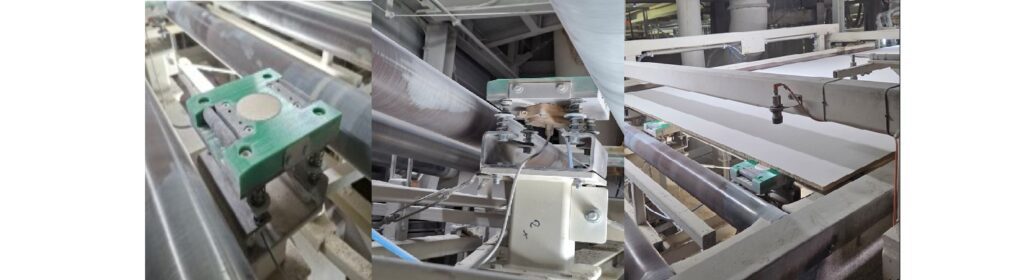
The DMMS system installed in Niftrik can measure right into the core of the gypsum board with a maximum penetration depth of 150 mm. The DMMS system can connect 16 sensors directly into the internal Digisys (programmable logic controller). The installation of the sensors is important and industry-dependent. To avoid obstructions and to provide a continuous moisture content output, the fiber gypsum boards are measured directly online within the roller track. This enables the sensor to make continuous moisture measurements along the entire length of the board without obstructing the fiber gypsum board production process.
The innovative mounting facility, designed and constructed by Ernst Cozijnsen, incorporates special built-in rollers with a spring assembly. The spring assembly dampens vibrations and ensures that the sensor follows the contours of the board. The special rollers maintain a constant distance of 0.2 mm between the sensor and the fiber gypsum board while also reducing wear on the sensor.
This design has resulted in more consistent and accurate measurements, reducing the need for maintenance. Four curves are stored in the PLC from James Hardie to provide flexibility regarding the use of the values that correspond to the four thicknesses of the company’s fiberboard products. This data is imported via Profinet and displayed as moisture in the boards. At Fermacell, the same DMMS as the online moisture measurement is used in the laboratory, but in a stationary offline configuration. Beforehand, fiber gypsum boards had to be dried for 24 hours in the laboratory to record moisture values. Now they are easily available within seconds.
The measuring system is regularly calibrated according to company instructions and a Pertinax test plate, which provides a steady known reference value to the sensor. A QR code applied to the gypsum fiberboard, coming from the production, can be read by a handheld scanner to select the correct calibration curve/board thickness. Thanks to the Profinet link, the QR code selects the right thickness/moisture curve so that it can provide an accurate moisture content. Values from the laboratory must match online moisture values. This provides an additional quality control check on the boards. These values are recorded and stored for quality and improvement purposes.
To prevent boards from drying for too long, which is both costly and detrimental to quality, additional ACO DMMS systems have been mounted before and after the dryer and before storage. This enables more effective monitoring and control of the drying process and quality control, resulting in better quality boards and significant savings in gas consumption each month.