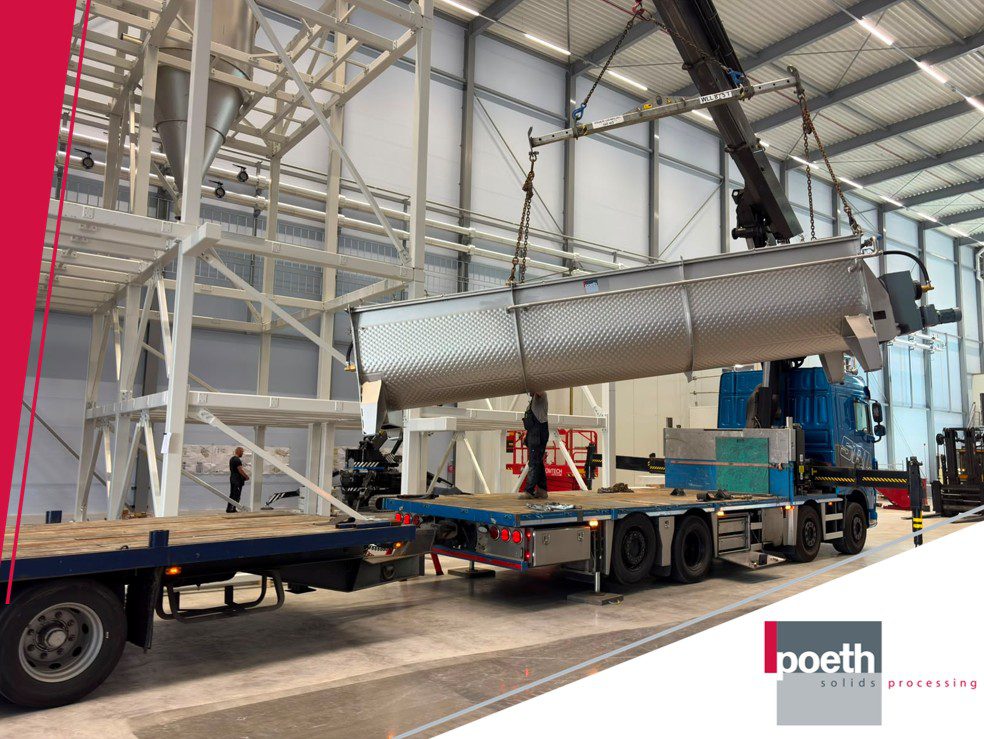
The first two of four screw heat exchangers have recently been installed as part of a new cocoa processing line. The units are designed to cool cocoa powder in a controlled manner after the grinding process.
Although a screw cooler may appear to be a relatively simple piece of equipment, designing a reliable and energy-efficient solution requires extensive knowledge of heat transfer, material flow and bulk solids behaviour. When cooling cocoa powder, not only the required outlet temperature and production capacity are important, but also product characteristics such as bulk density, particle behaviour, residence time, mixing characteristics and the thermal properties of the material.
Each screw heat exchanger is specifically engineered to match the customer’s process conditions. Poeth employs its own proprietary calculation model, developed in-house and validated through practical testing, in which thermal, process and mechanical parameters are combined to optimise the design.
In addition, Poeth has developed its own pilot-scale test screw heat exchanger. This facility is used to validate the theoretical calculation model against actual process measurements, ensuring that calculated performance closely matches real operating conditions.
The objective is not only to achieve the required product outlet temperature, but above all to design a screw heat exchanger that delivers reliable and predictable performance under all operating conditions.
The calculation model incorporates, among others, the following parameters:
The overall heat transfer performance is determined by the total thermal resistance of the system. In screw heat exchangers handling bulk solids, the heat transfer between the moving product and the heat transfer surfaces is often the limiting factor. Consequently, screw geometry, mixing efficiency, filling degree and residence time have a significant influence on the overall cooling performance.
In addition to the thermal calculations, mechanical aspects such as shaft deflection, torsional loads, thermal expansion, bearing loads and operational stresses are also incorporated into the design. This integrated engineering approach ensures optimum thermal performance combined with long-term mechanical reliability.
Although many material properties are available from literature, bulk solids frequently behave differently under actual process conditions. For this reason, Poeth Solids Processing operates its own testing facilities, where products can be evaluated under representative operating conditions.
During these tests, parameters such as the effective heat transfer coefficient, residence time, product flow behaviour, mixing intensity and overall cooling performance are determined. The resulting data are used to validate and continuously refine the calculation models, allowing the performance of full-scale installations to be predicted with a high degree of accuracy.
The combination of theoretical calculations, practical testing and decades of experience in bulk solids processing forms the basis for the reliable sizing of every screw heat exchanger.
In this application, cocoa powder is cooled immediately after the grinding process. Because cocoa powder presents a significant dust explosion and fire hazard, grinding takes place in a fully enclosed nitrogen recirculation system operating under inert conditions.
The screw heat exchangers have been specifically designed to operate within these process conditions and are fully integrated into the inert system.
Each of the four screw heat exchangers has a diameter of 1,200 mm and a length of approximately 7 metres. With the first two units now installed, another important milestone has been achieved in the realization of this modern cocoa processing line.
A screw heat exchanger is far more than a screw conveyor with a cooled jacket. Its performance depends on the correct combination of process engineering, heat transfer and mechanical design.
By combining proprietary calculation models with pilot-scale testing and decades of practical experience in bulk solids processing, Poeth develops screw heat exchangers that not only meet the required process capacity, but also deliver reliable, predictable and repeatable thermal performance.
This engineering-driven approach enables Poeth to provide optimised heating and cooling solutions for a wide range of bulk materials, including cocoa powder, milk powder, minerals, chemicals and biomass products.